What’s funny about it all is that “enraptured” is one of my most dear and darling feelings. I hope every morning for some odd looping video or blooming magnolia tree to rapture me up — to hold my whole lymphatic system in warm, complete, attention. I look for rapture like my momma does, bellering to cranked up music on the long drive home.
If you don’t know, “The Rapture,” is a generalized term for an event some Christians believe will happen (soon, but not yet) to unite them with Christ and Father God. The Rapture is typically either considered an event that happens before the Second Coming during the End Times, or an event that happens simultaneously with the Second Coming after the End Times. The guy who wrote this article, “The Rise of Rapture Horror Culture,” did a good job explaining the premise without losing legibility:
“There is no rapture in the Book of Revelation. Rather, rapture theory is stitched together from a few biblical fragments gathered from disparate sources. Three texts in particular: the promise in Revelation’s letter from Christ to the church in Philadelphia that “because you have kept my word of patient endurance, I will keep you from the hour of trial that is coming on the whole world to test the inhabitants of the earth” (Revelation 3:10); the assurance in Paul’s letter to the Thessalonians that after God raises from the dead those believers who have already passed, “then we who are alive, who are left, will be caught up in the clouds together with them to meet the Lord in the air, and so we will be with the Lord forever” (1 Thessalonians 4:17); and Paul’s declaration to the church at Corinth that “we will all be changed, in a moment, in the twinkling of an eye, at the last trumpet; for the trumpet will sound, and the dead will be raised imperishable, and we will be changed” (1 Corinthians 15:51–52).
From these fragments, rapture theory builds an idea that the saved, dead and alive, will be raptured up from the earth to heaven.”1
I was raised in a Rapture household. In the bathroom, in a curly wire frame, there was a letter directed at first responders, family, and friends, in the case our home was found empty. It explained the premise of The Rapture, informed the reader that they had been left behind, and directed them to scriptures that might provide guidance in the aftermath of the Christian population disappearing in the blink of an eye. The letter told them to prepare for the Second Coming, when Jesus Christ would return to earth in a blaze of trumpets to levy ultimate justice against the unbelievers.
The Rapture and Second Coming was the first genocide I learned about, before the Holocaust or Rwanda. At age eleven I metabolized the iconic Left Behind series in the same way I read historical fiction. I sorted out the “facts” from narrative details and character developments and filed them carefully away under “foundational systems.” I was a systems-focused child that believed I could compensate for the instability of the adults around me by figuring out the rules they lived by. Unlike many of my peers, who feared being left behind, I was confident that in the case of The Rapture, I would be taken up with the rest of Christ’s children. What haunted me in the church hallways and Walmart parking lots was the idea of leaving behind my neighbors and friends to damnation.
Within Second Coming teachings, The Rapture is the first step in the genocide of the non-Christians. Non-Christians that are left behind have an indeterminate amount of time (often portrayed as seven years) to assimilate and become Christian, otherwise they face the judicial process of the Second Coming. After this process, only Christians will remain to build a new earth.2
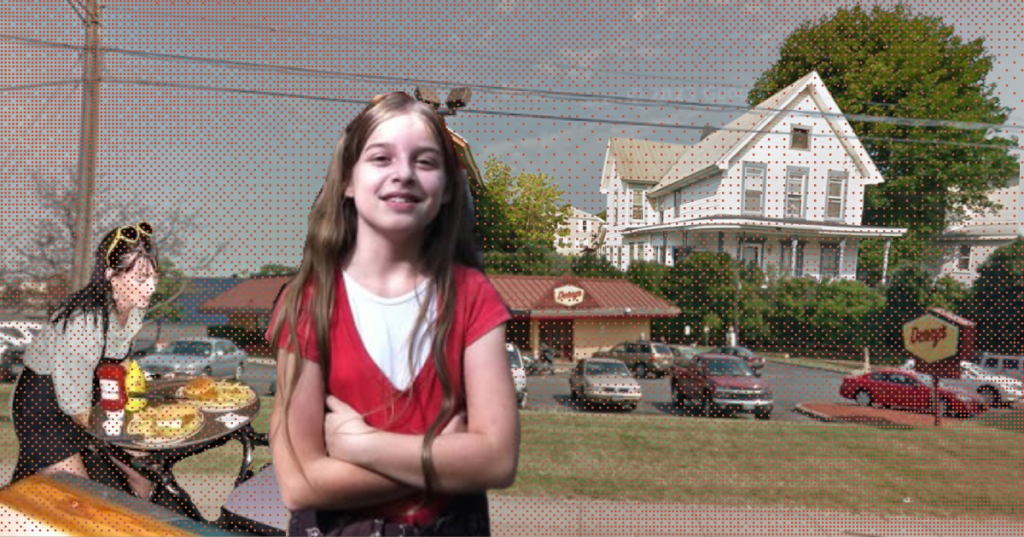
In a Denny’s diner I embarrassed my mother by becoming emotional about the waitress’ soul. The waitress was a young woman with lip gloss and patience. All I knew about her was that she would suffer deeply. It was a terrible thing to know — that this young woman would feel the abandonment of God after the Rapture, endure the literal warfare of the end times, and she may not ever really know why. My father suggested I pray for her, but my mother’s embarrassment and his nonplussed focus on his cheeseburger showed me that despite believing the same thing I believed, they didn’t care much about the reality of her dire situation.
I imagine learning about The Rapture as an adult, and the whole of Evangelical Apocalypse theory, is like trying to comprehend the intricate hallucinatory spirituality of the Warrior Cats book your twelve year old is obsessed with. Stay with me. Remember this is real.
Or, real to some. The Pew Research Center ran a study with over 10,000 adults from an online survey panel that was recruited through national random sampling of residential addresses. The study was focused on the interplay between religions and environmental stewardship, but it also gave us a silhouette of how many Americans believe in the second coming of Jesus Christ and the “end of days.” Because of the wide variety in belief systems, I can’t know how many strangers believe someday they will simultaneously dissolve into the heavenly dimension, but the following numbers tell me how many individuals are participating in the general field of Evangelical Apocalypse Theory. In 2022, 55% of Americans believe in Jesus Christ’s second coming, 39% believe we are living in the end times, and 20% believe in premillennialism (the idea that chaos and suffering will increase as we get closer to the time of the second coming). One-in-ten Americans say they believe the second coming of Jesus will definitely or probably occur during their lifetime.3 This is not an insignificant number of people.
As a homeschooled Evangelical child the majority of adults who regularly showed up in my life professed faith in Jesus Christ and the Second Coming. They believed what I believed. And so I knew something about them that was unholy and terrifying — they believed nearly every stranger they interacted with was actively suffering the greatest suffering, the absence of Jesus Christ, they believed these strangers were due for final annihilating genocide, they professed to be intimate with the truth and comfort that could save each individual, and they chose in nearly every hour of their life to do nothing about it. And I was seeing the best of them: older teens brave enough to wear WWJD bracelets to public school, adults willing to volunteer an hour of their week folding church pamphlets, evangelists who would occasionally ask to pray for grocery clerks and mothers in the park. The little actions were disproportionate to the reality my adults professed.
If I were a slightly less boolean child, this may have been when I realized some adults don’t carry beliefs to live them out, but to meet an internal emotional need. Unfortunately, between being a little dim and a lot indoctrinated, I did not put two and two together until much later, and lived six formative years trying to understand the dark boundaries of Christian care.
What’s funny about it all is that “enraptured” is one of my most dear and darling feelings. I hope every morning for some odd looping video or blooming magnolia tree to rapture me up — to hold my whole lymphatic system in warm, complete, attention. I look for rapture like my momma does, bellering to cranked up music on the long drive home. At my core, I understand the emotional need to be taken. This, the Rapture, is separate from escape. This is a spirit-removal-reward to be enacted without personal agency or responsibility.4 This isn’t a rape, there is no body. The body is gone and the only thing left is the part of us closest to God. The promise is that this will be the closest to God we’ve gotten yet and the joyful oblivion of that moment will nullify every other humanly data point we have access to. I seek rapture every day.
But there is no Rapture without the Second Coming, at least not in the belief structures I was presented with as a child or young adult. The promise comes at the cost of ultimate justice, a genocide. So, I do not seek The Rapture.
I’m writing this all out as I work on a piece of fiction meant to take place during and after The Rapture. There is, of course, the horror to write about, true to genre. The original premise I landed on was little more than horror: if an unsaved young woman’s abuser is raptured, and she is left behind, what does she do? Now, after chewing on my own little terrors, I wonder if there is room for sacrilege, for reveling in the wonder of an earth free of uncaring Christ-born. With one-in-ten Americans no longer numbed by and preoccupied with the Second Coming, what could we accomplish? To imagine the world post-rapture, a world without any of those unholy terrifying adults who believe in it, is somewhat cathartic to me. And so, I understand the genocidal urges embedded in The Rapture after all. How easy it is to understand the world as better off without those people in it. What if we could just get rid of everyone I am afraid of?
- Beal, Timothy. 2022. “The Rise of Rapture Horror Culture.” The National Endowment for the Humanities. October 27, 2022. https://www.neh.gov/article/rise-rapture-horror-culture.
↩︎ - Willmington, Harold. 2008. “What You Need to Know About The Rapture of the Church: Part 2.” https://digitalcommons.liberty.edu/will_know/12 ↩︎
- Diamant, Jeff. 2022. “About Four-In-Ten U.S. Adults Believe Humanity Is ‘Living in the End Times.’” Pew Research Center. December 8, 2022. https://www.pewresearch.org/short-reads/2022/12/08/about-four-in-ten-u-s-adults-believe-humanity-is-living-in-the-end-times/.
↩︎ - The well-educated apologist that lives around the back corner of my brain would like to let you know that Evangelicals believe their choice to pursue salvation is the moment of personal agency wherein they embrace The Rapture. I no longer believe the structure of “opt-in-or-die” promotes meaningful personal agency. ↩︎

 Sticker Booklet
Leave a comment